
It is December, my dudes, which means the event is over and we’re finally crawling back into something that resembles a normal, stable work routine. It feels surreal writing from the flip side of something we’d been grinding toward in whatever tiny scraps of free time we could grab these last few months.
Harvey went to bed past 2 a.m. more times than he will ever admit, and honestly, we’re still recovering from this past weekend.
We were pretty nervous to show where we were at. When you stare at something you’re making for so long, you kinda lose all sense of whether it’s “good enough.” I still don’t know, and I’ve been playing games for most of my life. You’d think I’d be able to gauge that by now, but nope. One thing you learn while making something is that you really are your own worst critic.
Harvey likes to remind me just how many visual crimes AAA studios hide in their games. We need to learn to be gentler with ourselves and less hypercritical.
Another thing we learned through this whole grind: making a game is insanely difficult and way more time-consuming than anyone warns you. Holy shmokes, my guys… we are tired. 😂
But moving on, let us share with you what we’ve been working on since the last blog, what we pulled together leading up to the event, and then, finally, a few words about the event itself.
What We’ve Been Working On
(Megan) Artwise
I am happy to say I completed everything I had on my to-do list for the early demo.
I spent some time making the loading screen for the game:

This one, Harvey animated, so the green liquid fills the tank as the game loads. I like.
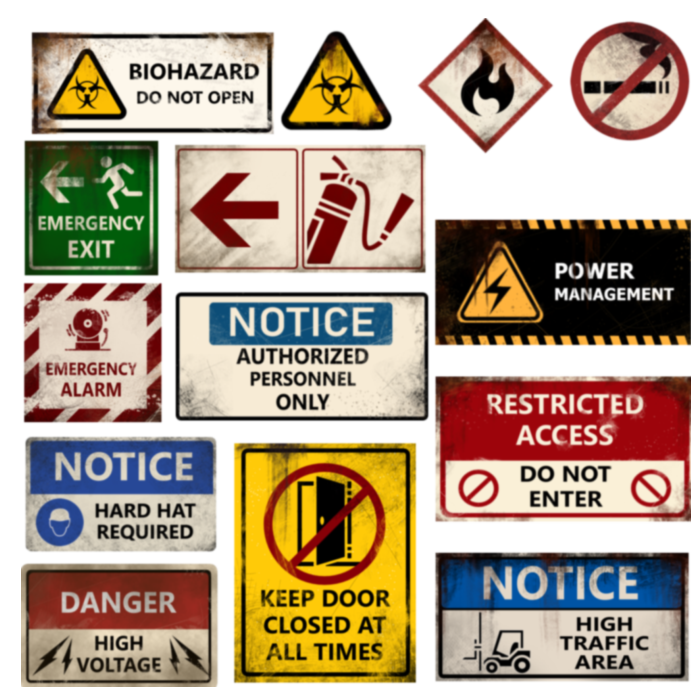
I also spent a couple of hours making some signage we’ll be using throughout the game:
3D Assets
Moving on to the 3D side of my job. I won’t be showing the assets I created for the deceased characters you encounter in the level. I debated it for a bit, but honestly: 1) some people might not be comfortable seeing that, and 2) it dips a little too close into spoiler territory.
But I will show the model I made for one of the creatures you meet – The Hunter.

I was really happy with how he turned out, but honestly, what made me happiest was how quickly I was able to create him. If there’s anything this year has taught me, it’s how far I’ve come with Blender. Seeing that progress genuinely makes me happy.
I also created a list of objects to be placed into the world. I won’t show each object, but just an overview so you get the idea:

Someone at the event kindly pointed out that the hospital beds are too low to the ground…back-breakingly low…which is very obvious now…so, thank you.
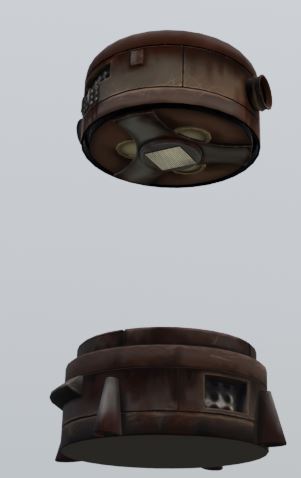
In addition to these objects, I also textured a device you’ll encounter throughout the game. Harvey made this asset. It’s giving ‘Fallout’.
And, finally, for the assets, I worked on something we call the ‘Bile Bloom’. This we’ll get into further on in the game. Let’s just say it’s a growth of some kind…

Game Intro Sequence
In the final week leading up to the event I made a quick intro for the game. This one is just a stand-in for now. For the final demo release, I plan on making a full motion comic. These are just some images I painted for the intro:


Event Art
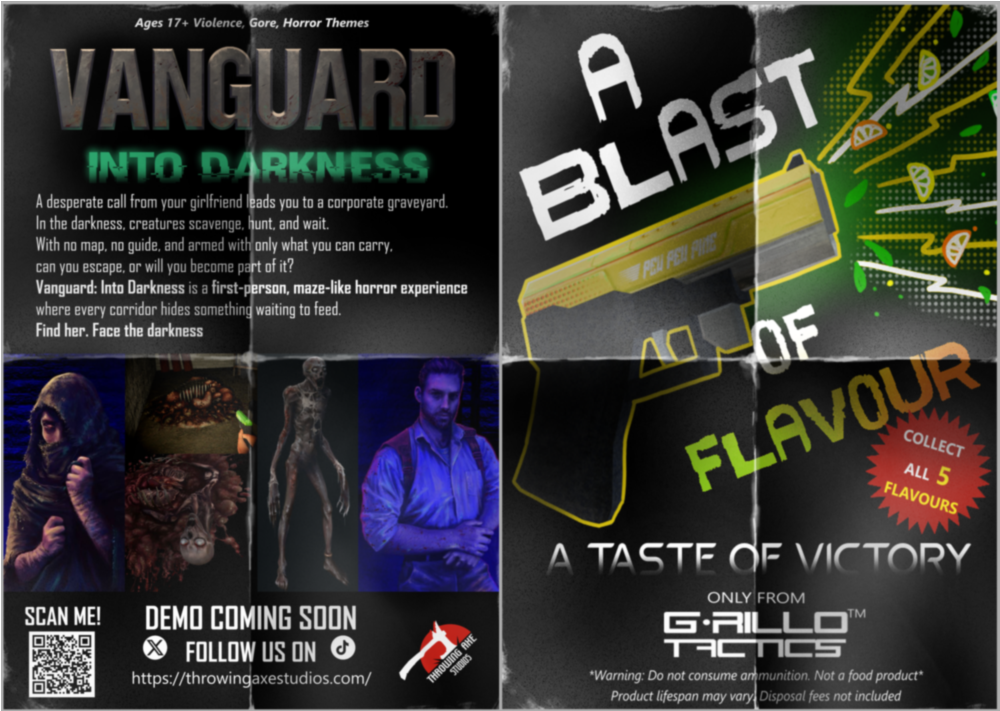
In addition to all the art I did for the demo so far, I also threw together some designs for a poster and flyer for the event.

And, for funsies, I made a sticker design. This one is actually for a character you encounter.


(Harvey’s side) Dev work
A lot of the last month and a half’s work was refactoring older features to fit into the new interaction framework. Everything in the game now runs through a unified system for interactable objects and pickups. That means when I create something like a door, I’m really creating a generalised interactable that happens to run door-specific logic, play its animation, and handle opening when the player interacts with it.
I also focused on wiring up and standardising the death logic for all enemy types. The code has existed in the project for a while, but it was time to formalise it with a dedicated do_death() function so every enemy handles dying in a consistent way.
Creating the scavenger enemy was a journey in itself. If you’ve been following the blog, you’ll know I’ve made several attempts to build a proper finite state machine for our enemy AI. In a way, that finally came together. The system is now functional enough to support two main types of wandering enemies: attack_scavs and routine_scavs.
Attack_scavs spawn specifically to hunt the player. They’re usually triggered when another enemy is under pressure and calls for help – simple, direct, and dangerous.
Routine_scavs, on the other hand, spawn with a set of routine nodes assigned at construction. They wander between these points, performing different ambient behaviours like eating or resting. Some have an aggression threshold: if they’re attacked or spot the player, they’ll switch into attack mode.
I’m definitely not a professional rigger, and I won’t pretend otherwise. I ended up rigging and animating the scavengers not once, not twice, but three times just to make sure they didn’t move like Shaggy scrambling up a wall. They still ragdoll so dramatically that it looks like they’re trying to inspect their own rear ends.
That said, I learned a lot about animation workflows, especially how to connect animation states to the enemy’s current behaviour.
I also began adding controller support, but ran into some complexity with UI navigation in menus like the inventory and data archive. That’s going to be a big focus for me in the new year. I want players who prefer controllers to have just as smooth an experience as those using keyboard and mouse.
We will be uploading to YouTube in the new year, showing off the animations of these different behaviours.
Girls in Gaming
On the morning of Saturday, 29 November, we made our way to the Londt Park Sports Club for the first-ever Girls in Gaming event held in Port Elizabeth. Together, we were operating on about a total of 2.5 hours of sleep. We won’t lie…but we did spend the entire 7 hours watching the time tick by. This was our first big step towards our goals of becoming a full-time studio, and we were too brain-dead at the time to fully take it in.
Although we worked on the demo until the last moment, we were able to pull together the core game loop – Enter the catacombs, fight through some hostiles, reach Shadow, collect power cells, and power up the level. The main animations are in the game, but unfortunately, due to the time crunch, we couldn’t include all of them. Also, we were able to add a lot of the assets to populate the world. However, we do plan on customising this further.
What is quite funny, though, is that we were both so excited to stop working on the game for the entire month of December. The plan was to start up again in January, fresh-eyed and bushy-tailed. And the moment we woke up on Sunday morning, sitting in bed with our tea and coffee, we looked at each other and realised we wanted to continue working.


I want to say special thanks to our dear friend, Kat, for standing by our side this weekend. The motivational support was worth more than she probably realises. And we hope she will be by our side for many years to come.

We received a lot of feedback and suggestions. Some were recurring, and so these will be fixed first. In fact, Harv has already begun working on these.
Thank you so much to everyone who came to the booth, those who braved the catacombs (some more than once), the ones who wrote suggestions, the ones who stopped to chat about the project, and even those who just stopped to watch from a distance or grabbed a flyer. Every bit of it was noted and appreciated. The fact that you chose to spend even a moment stopping to give us some consideration or time – we appreciate it all!
Special shoutout to the gents below who were the only ones who got all the way to the end of the demo! Their support and suggestions are highly noted and appreciated.

What’s Next?
We plan on releasing the early demo at the beginning of the new year. Happy holidays! 🥂

