Thank You!

Before we jump right in, we want to give a huge thank you to everyone who has signed up for our newsletter. Your support means the world to us. We’ll be using the newsletter to share updates, future releases, behind-the-scenes content, and some early sneak peeks at gameplay. So if you haven’t signed up yet—what are you waiting for?
What We’ve Been Working On
As promised, we’ll be sharing our progress in blogs every 3 weeks. This not only helps keep us consistent, but it also gives us a great way to track our progress and celebrate the small wins along the way.
Lights in the dark
Hello again, Harvey here! In our last update, I mentioned needing to rebuild the flashlight utility—well, that’s now complete. Since the flashlight is your primary light source in the dark, we wanted it to do more than just illuminate; we wanted it to add tension. To keep you moving through the labyrinth, the flashlight runs on batteries scattered throughout the level. But don’t expect a fresh pack—these are the kind of half-used, unreliable batteries you’d find in your junk drawer. That means your light won’t last forever, so use it wisely… and I hope you’re not afraid of the dark.

Saving and Loading
Since our last update, Megan and I have been refining the scope of our demo, and one of the features we’ve decided to put on hold is the saving and loading system. Given that the demo is designed to be played in a single session of about twenty minutes, we don’t expect players to need a save function. This also makes it easier for us to share the game with you—anyone can just press play and jump right in.
But don’t worry, the work we’ve already done on saving and loading isn’t going to waste. We’re simply disabling it for now so we can focus on other key areas of development.
Level Design Update!
The level design for the demo is about 60% complete, including asset creation, texturing, and importing everything into the world to make it feel truly lived in. One of the challenges we’re constantly working on is striking the right balance between detail and clutter. We want the environment to feel immersive without overwhelming the player, and fine-tuning that balance will be an ongoing process.
Enemy AI Update!
In our last update, I talked about working on finite state machines to give enemies more dynamic behavior. Well, after a lot of trial and error, I think I’ve found a good balance. There’s still plenty of work to do, but I now have a working proof of concept—where you can enter a room with multiple enemies, and each one reacts to you in its own way. Some might ignore you, while others will attack. This is just the beginning, but it’s exciting to see the AI coming to life!
Bringing Alex to life
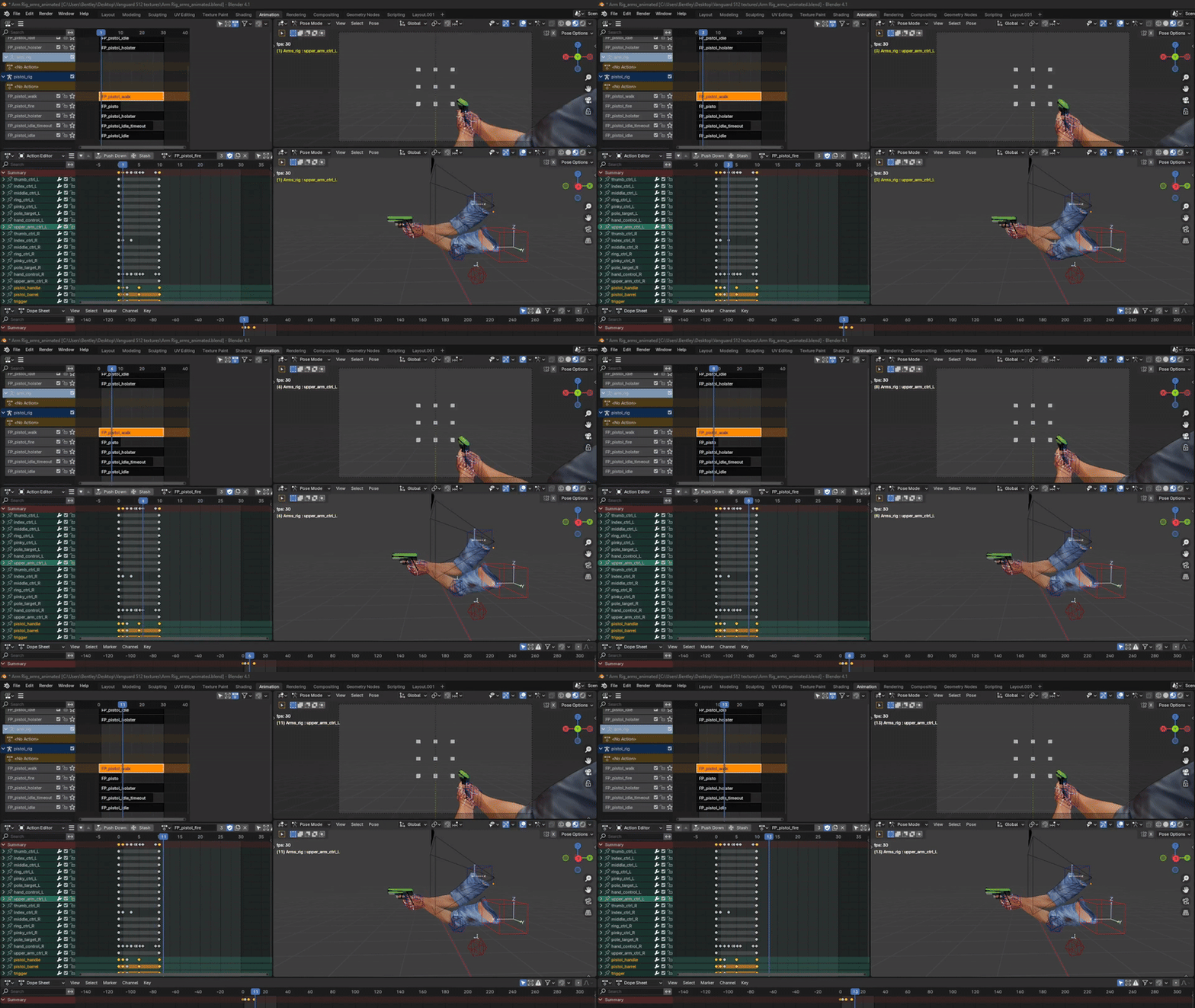
One of the tasks on Megan’s plate was creating the arms for Alex, and she absolutely nailed it! You’ll see more about that in her section below. My job was to rig the arms and get some key animations working—like firing your weapon.
Learning rigging has been a personal milestone for me since it plays a huge role in bringing creatures, characters, and machines to life. With my experience in Blender, I took on the challenge head-on.
Something fun I discovered along the way is that many people don’t realize that in first-person games, the only part of the player that actually gets rendered is the arms. I had a great time explaining this to friends and watching their reactions as they slowly realized they’ve been running around in most games as a pair of floating hands!
There’s still plenty to do, and I’m hard at work refining these animations to make them feel just right.
Artwise
I kicked off this three-week sprint with an illustration for our marketing. It features our main character, Alex, using some of the core mechanics—flares and glowsticks. The glowsticks help mark where you’ve been, while the flares can distract potential threats.

While this was the only item I completed from my “What’s Next” list from the last blog, I’m really happy with how it turned out. It also shows a little sneak of our boy, Alex.
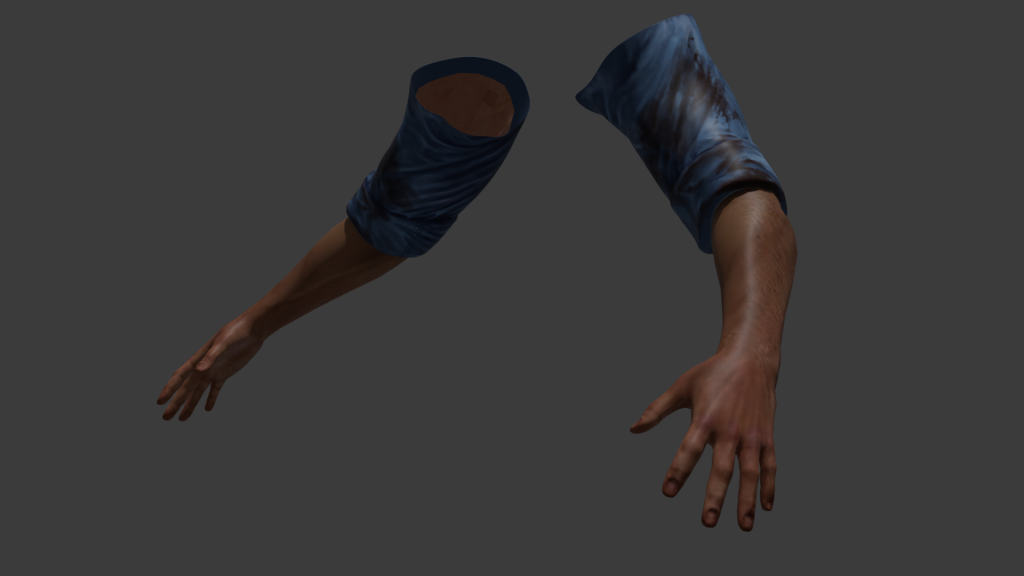
I also textured our FPS rig and discovered that I really enjoy painting in Blender. So, yay for learning new things.
On top of that, I’ve been working on concept art for a character we can’t reveal until the demo, as well as environmental details like blood splatters and mushrooms.

Story and Writing
I’m currently learning Twine, a tool we’ll be using to create our dialogue trees. While we’re not aiming for anything too complex, we believe giving players the ability to choose Alex’s responses will make him feel more alive—like a real person you’re following through the game.
Marketing
On the marketing side, Harv and I have been diving into a lot of videos and a book by game marketing consultant Chris Zukowski—highly recommended if you’re interested in indie game development. We’ve mapped out our roadmap and have a clear plan of what needs to be done each month.
What’s Next?
And speaking of what needs to be done each month… Over the next three weeks, we’ll be focusing on the following:
Art (Megan):
- Converting character concept art into 3D assets.
- Turning the mushroom concept art into 3D assets.
- Texturing our first weapon.
- Creating concept art for the team of characters I mentioned in the last blog.
Story:
- Finalising the dialogues and conversations that will be featured in the demo.
Mechanics/Development (Harvey):
- Rebuild the Weapon manager – working with the animated arm rig.
- Improving the enemy AI
- Adding Flares
Well, that’s all she wrote. See you in the next one!